Measures & Tools
The Addiction Science Team develops and validates measurement tools to support researchers, providers, and policymakers working in addiction science. Our tools are freely available for use. Click any measure below to access it and its related publication.
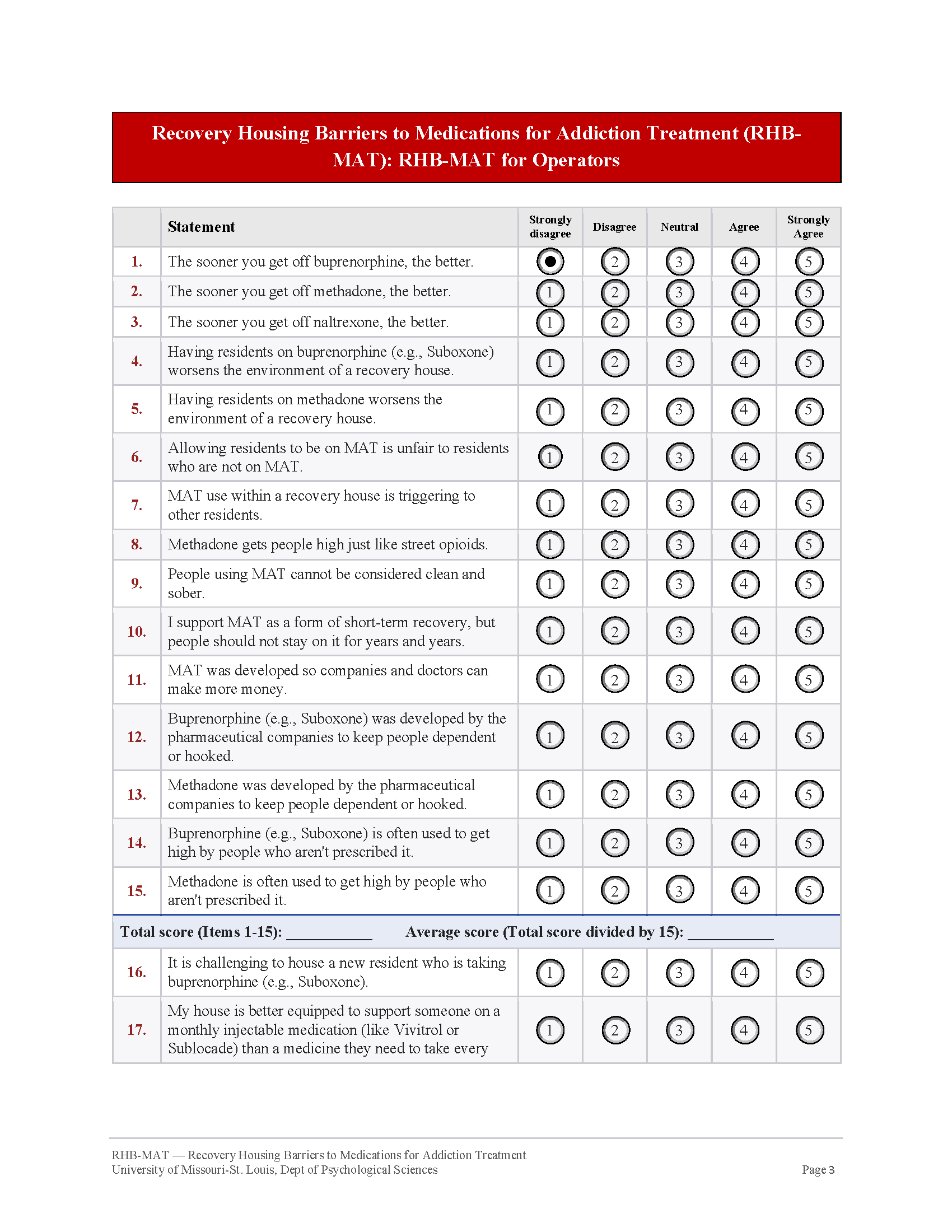
RHB-MAT
Recovery House Barriers to Medications for Addiction Treatment
Validated
The first validated measure to assess attitudinal and capacity-related barriers to medications for opioid use disorder (MOUD) in recovery housing settings. This tool has with separate versions for operators and residents. Uniquely captures how stigma differs across medication types (methadone, buprenorphine, naltrexone).
-
SUD researchers, Recovery housing operators, State administrators, Funders
-
Operator version
15 items · 4 attitudinal domains
12 items · 3 capacity domainsResident version
10 items · 3 attitudinal domains
MO I-STARR project
Coordinating Overdose Response Partnerships and Support (MO-CORPS)
MO-CORPS is focused on integrating first responders work with evidence-based public health models.
Targeted Counties: St. Louis City, St. Louis County, St. Charles, Jefferson, Greene, Jackson, Clay, Pulaski, Laclede, Warren, Ste. Genevieve, Phelps, Dent, Gasconade, Montgomery, Butler, Texas, St. Francois, Buchanan, Lincoln
-
1) Evidence-informed training for first responders working with people who use drugs
2) Improving overdose response through naloxone distribution with local public health agencies and first responders
3) Developing resource referral networks for first responders in 20 target counties with the highest overdose rates across the state
-
SAMHSA FR-CARA grant administered through the MO Department of Health and Senior Services.
-
The Addiction Science, Practice, Implementation, Research and Education lab (ASPIRE)
The Addiction Science, Practice, Implementation, Research and Education (ASPIRE) Lab is located within the University of Missouri-St. Louis Department of Psychology under the leadership for Dr. Rachel Winograd.
-
The ASPIRE lab is focused on community-informed research to enhance research-informed practice and works in close partnership with all of the collaborative partners and projects connected to Addiction Science team.
-
-
Drug Overdose Trust & Safety + Mobile (DOTS+MOBILE)
The DOTS+MOBILE project empowers first responders to reduce opioid overdose deaths in Missouri.
Target Counties: St. Louis City, St. Louis County, St. Charles, Jefferson, St. Francois, Washington, Franklin, Boone, Phelps, Greene, Jackson, Buchanan
Opioid Use Disorder Pharmaceutical Treatments: Investigating a Model and Measure of Intervention Stigma toward Medication (OPTIMISM)
OPTIMISM aims to develop a dimensional model of Intervention Stigma toward medications for opioid use disorder (MOUD) that captures stigmatizing attitudes and actions by policymakers, healthcare personnel, and members of the general public.
The St. Louis Black Harm Reduction Coalition (BHRC)
The St. Louis Black Harm Reduction Coalition (BHRC) is focused on applying the principles of harm reduction explicitly within Black communities in St. Louis.
The BHRC core vision is: a St. Louis community where Black people who use drugs are empowered, healthy, and treated with dignity.
The emerging mission is to: educate and unite the St. Louis community around harm reduction to eliminate substance use-related deaths amongst Black people and the structural harms of racism for Black drug users. Williams and Associate Inc will host the St. Louis Black Harm Reduction Coalition in Partnership with the UMSL-MIMH Addiction Science Team.
St. Louis Medication Access Project (STL MAP)
The St. Louis Medication Access Project (STL MAP) aims to reduce barriers to methadone treatment for opioid use disorder by providing individuals seeking treatment with medication lockboxes and transportation assistance, including bus passes and rideshare vouchers.
-
1) Training for First Responders
2) EMS Initiated Field Buprenorphine
3) Collaborations between First Responders and Community Treatment
4) Naloxone Distribution
-
-
-
Aim 1: To establish a model of what Intervention Stigma is and how it works
Aim 2: To pilot and create a comprehensive measure of Intervention Stigma tailored for three groups
(healthcare providers, decision makers, and the general public)R15 AREA Aim: To develop empirically rigorous substance use-focused research and training infrastructure within the Dept. of Psychological Sciences at UMSL to build upon the years of community-focused implementation work of the Addiction Science team
-
Sept 2024 - Aug 2027
-
National Institute on Drug Abuse (NIDA), through the NIH Helping to End Addition Long-term (HEAL) Initiative
-
Washington University in St. Louis (Co-I: Devin E. Banks), Wayne State University (Co-I: Erin F. Madden)
-
-
Build sustainable infrastructure for a formal, independent Black-led harm reduction organization
Reduce substance use-related deaths and harms among Black people who use drugs through community-driven approaches
Address structural racism that contributes to disparities in substance use outcomes
Build capacity among community partners to sustain and expand harm reduction efforts in the Black community
-
July 2024-July 2027
-
Missouri Foundation For Health
-
-
-
The Cigna Group Foundation, through The Cigna Group Health Equity Impact Fund

